
What Couples Miss on Their Wedding Day -And Why It Shows in the Photographs
The most common question I receive is: what do we do with our hands?
Here is my honest answer and why the question itself reveals something important about how we think about wedding photography.
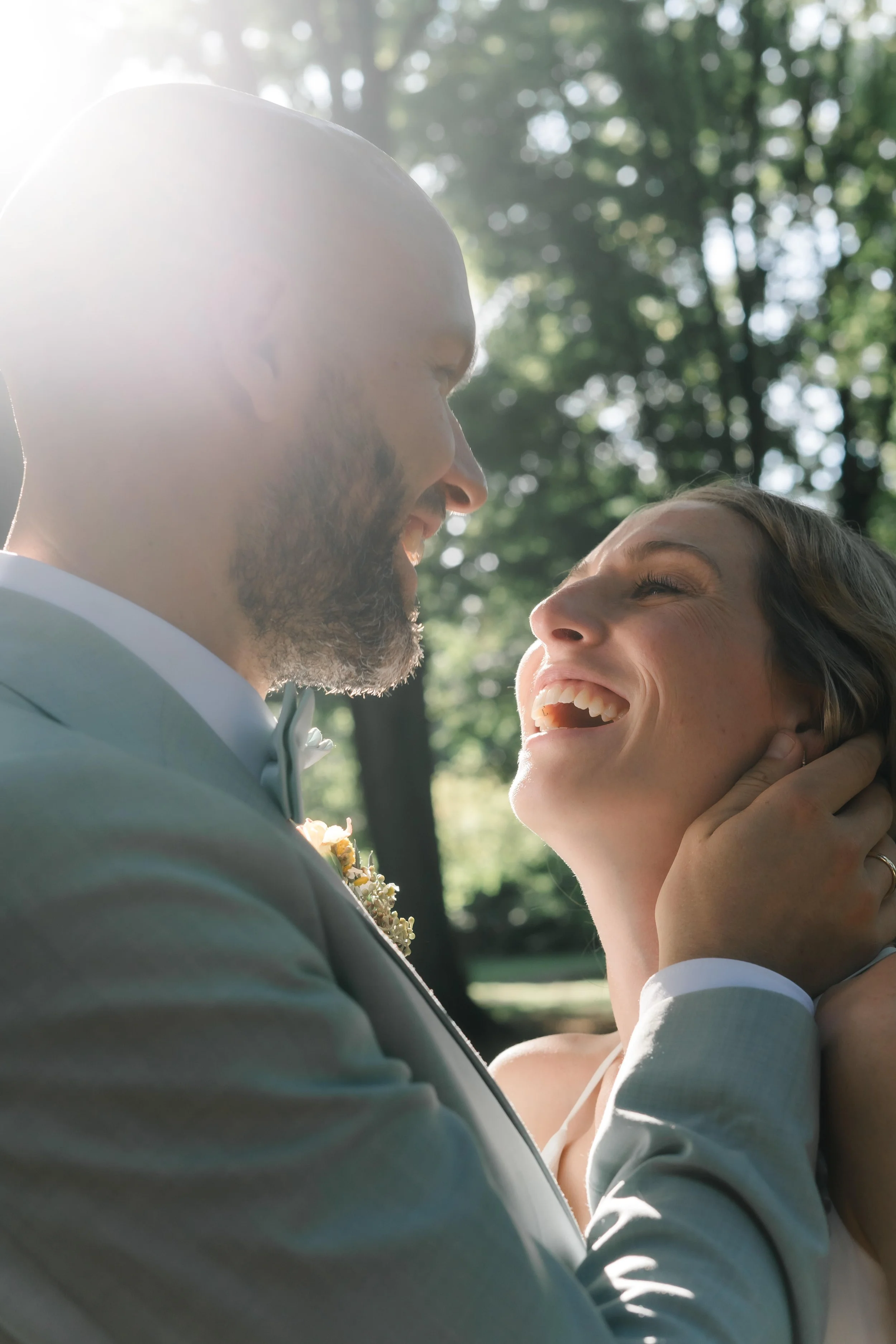
There is a photograph I keep coming back to. A couple, laughing. Not at the camera but at each other. Her shoulders are down. His hand is loose around hers. Nobody is performing anything.
It was taken about forty minutes into the wedding day, after the ceremony, after the first wave of family photographs. The moment when most couples exhale without realizing it.
That exhale is what I am always waiting for.
The wedding day most couples imagine
Most couples spend months - sometimes years - planning a wedding day. The flowers, the light, the timeline, the table settings. They have a version of the day in their heads, and they arrive at it carrying the full weight of that version.
Will the weather hold? Will we make the schedule? Will the food be good? Will I know what to do with my hands?
That last question is the one I hear most often, usually whispered just before we start. I am not photogenic. I do not look like a model. I never know what to do in front of a camera.
What they are really saying is: I am afraid of being seen and found lacking.
That fear is completely understandable. It is also the thing that makes photographs feel stiff, distant, and unlike the people in them.
What I do before I photograph anything
When I arrive at a wedding, I do not immediately raise my camera. I watch. I read the room, who is nervous, who is already relaxed, where the light is doing something interesting, where the emotional center of the day is gathering.
And when I am with the couple, the first thing I do is not take a photograph. I talk to them. I tell them what I see , that they look exactly as they should, that the light on the terrace is extraordinary, that the flowers are more beautiful in person than in any inspiration image. I tell them to walk beside each other and forget I am there.
Sometimes I make them laugh. Not with a joke necessarily, sometimes just by pointing out something absurd about the situation, or by saying something so unexpectedly honest that the performance drops for a second.
That second is when I photograph.
Because in that second, something shifts. The shoulders come down. The hands stop being hands-that-don't-know-what-to-do and become hands that are simply holding someone they love. The face stops being a face preparing to be photographed and becomes a face that is present somewhere.
That is the photograph. Not the posed version of it - the actual one.
What presence looks like in a photograph
There is a quality in photographs of people who are truly present that is difficult to describe but immediately recognizable. It is not about smiling or not smiling. It is not about looking into the camera or away from it. It is something in the body, a looseness, a weight, a sense that the person is actually somewhere rather than performing being somewhere.
When I look at the photographs I am most proud of, they share this quality. The couple is not thinking about the photograph. They are thinking about each other, or about something I just said, or about nothing at all , just the feeling of the day around them.
That is what I mean when I say I do not pose you. Posing produces a record of how someone stood. Presence produces a record of how someone felt.
The moments couples miss because they are managing the day
Here is the thing about wedding days: they move fast, and the mind tends to run slightly ahead of the moment, checking off what has happened, anticipating what comes next, monitoring whether everything is going according to plan.
This is natural. It is also the thing that pulls people out of their own wedding.
The guests who traveled from far away to be in the same room as you. The way your partner looked when they saw you for the first time. The small, unrepeatable details. A grandmother's expression, a child asleep under a table, the quality of the late afternoon light just before dinner.
These moments do not announce themselves. They happen quietly, in the periphery, while you are thinking about the next thing.
My job is to be in the periphery. To notice what you cannot notice because you are inside it. And to bring you back, gently, into the moment you are actually in , so that at some point during the day, you are not managing your wedding. You are at your wedding.
Why this matters for the photographs
The couples who are most present on their wedding day do not end up with better photographs because they are more attractive or more photogenic. They end up with better photographs because they trusted the day, each other, and the person behind the camera.
That trust is something I work to earn from the first moment I arrive. It is not a technique. It is a way of being in the room.
When it works, you can see it. In the shoulders. In the hands. In the laugh that nobody planned.
That is the photograph I am always looking for.